Advisory for Canadian nonprofits
Clear funding decisions. Practical support for your team.
Funding strategy, grant application support and ongoing advisory for Canadian nonprofits. We agree the priority, deliverables and time allowance before work starts.
No pitch deck, no pressure. If we're not the right fit, we'll say so on the call.
- Registered charities & nonprofits
- Calgary-based · Across Canada
- Built by Grants-Ease
- Board-ready documentation
One source of truth
Everything your team pulls from, in one place
- Budgets
- Deadlines
- Case-for-support library
- AI workflows
- Grant history
- Reports
6 disconnected tools. Nothing talks to anything else.
The pressure
Demand is climbing. The dollars behind it are not.
2/3
of Canadian charities report they cannot meet the demand for their services.
−17%
decline in the share of Canadians claiming charitable donations over the past decade.
Source: CanadaHelps, The Giving Report 2026
Program data lives in three spreadsheets and one person's head.
Grant reporting takes two weeks that should take two days.
Every funder application starts from a blank document.
Staff are already using AI tools, quietly, with no policy behind them.
The CRM was set up for a version of the organization that no longer exists.
Impact is real, but the evidence for it is scattered.
The reframe
Evidence and capacity shape a useful funding plan.
Under pressure, most teams reach for the visible lever and write more applications. It feels productive, and sometimes one well-scoped application is exactly what's needed. What it can't do is stand in for the evidence behind it, or for the hours a review takes — and a funder can tell when those inputs are thin.
So we start somewhere less dramatic. We get clear on the need, the evidence you can actually supply, and the capacity your team has. Then we agree the paid scope: deliverables, hours and limits. Where AI is useful, we use it for drafting, and a person reviews what it produces before anything leaves the door.
One client needs a decision brief, another a single application, a third ongoing advisory. The sequence follows the agreed need, not a fixed order.
The method
A clear scope, then practical work.
01
Scope
One priority, agreed limits
We agree the priority, the deliverables, and the time allowance before work starts, so the scope is written down and understood by both sides.
02
Review
What you have, what's missing
We review the evidence you already hold — documents, data, deadlines, past submissions — and set out the gaps plainly before anything is drafted.
03
Work
Contracted work, human-reviewed
We do the work we agreed, within the hours allowed. A named person reads every output before it reaches you, and your team keeps the decisions.
04
Decide
Progress reported, next step chosen
You receive a written progress brief and a clear recommendation. Then you decide whether to continue, pause, or stop.
Scoped outputs
Deliverables agreed before work begins.
Examples of what a scope can include, not a standard package. What you receive is what your agreed scope and paid hours cover — no engagement includes all eight by default.
A funding decision brief, if that's the scope.
One opportunity assessed for fit, gaps, and next steps, within the hours agreed for it.
A grant application draft, when commissioned.
One agreed application drafted from evidence your team supplies, with one consolidated revision.
A monthly progress brief, on advisory terms.
What moved, what's blocked, and what needs a decision, sent each month of an ongoing engagement.
Process notes, where documentation is in scope.
How a task actually runs, written down so it doesn't live in one person's head.
Workflow recommendations, after a review.
Where a repeating task could be lighter, with a human check kept at each step that matters.
A funder-fit review, if you want one.
A read on which funders suit your programs now, and which are worth the effort to pursue.
Reusable source material, when commissioned.
Core program, impact, and need language you keep and adapt, rather than rewrite each cycle.
A next-step plan, at the end of a piece of work.
What's done, what remains, and what you're choosing to take on next.
Fit check
Honest about who this suits.
This is for you if
- You're a nonprofit team or institution with a named decision-maker who can agree the scope.
- You have a defined need: a funding decision, one scoped application, or ongoing delivery.
- You can supply the evidence the work relies on — financials, program details, past reports.
- You have a realistic budget and timeline for what you're asking for.
- You'll review the work before it goes out, and someone on your side owns the final call.
This isn't for you if
- You want a guarantee of a funded outcome — the funder's decision is never ours to make.
- The evidence the work depends on isn't available and can't be gathered in the time there is.
- You need open-ended support with no agreed scope, hours or deliverables.
- The deadline can't be confirmed against the time the work actually needs.
- You're hoping AI drafting replaces the evidence and review your funder still expects.
Engagements
Choose the scope that fits your needs.
Funding Decision Brief
CAD 750
One discussion · up to 3 total hours
A focused decision on whether an opportunity is worth pursuing.
- One discussion
- Written fit, gaps, and next-steps brief
- No-fit is a valid finding
- Application work quoted separately
Ongoing Strategy & Delivery Advisory
CAD 4,500
per month · initial 3-month term · CAD 13,500 total
Focused strategy and delivery support for one organizational priority.
- Up to 16 total hours per month
- One priority workstream
- Two decision meetings per month
- Monthly progress brief
- New builds and applications quoted separately
Light Advisory
CAD 950
per month · up to 3 total hours
A lighter monthly option for focused advice and review.
- One monthly session
- Review of agreed materials
- Extras quoted separately
- Cancel before the next monthly renewal
Ongoing Strategy & Delivery Advisory: from CAD 3,500 per month for an initial 3 months, with up to 12 hours per month, one priority workstream, two decision meetings per month, and a monthly progress brief. New builds and applications are quoted separately.
Grant Application: CAD 3,500 for one agreed application using client evidence and one consolidated revision. Complex research is quoted separately. The funder makes the funding decision.
Institutional Grant Systems Program: typically CAD 15,000–25,000 for 15–25 organizations. Seat term, training, support, and reporting are agreed before quoting.
Standard hourly rate: CAD 250. Selected scoped engagements may be CAD 200 per hour by agreement. Applicable taxes are additional.
Start with a short conversation about your needs, timing and budget. We will decide whether a paid brief, project, advisory engagement or program is the right next step.
Questions
The things people ask first.
Steal our board-ready AI Use Policy template
The same document we hand to clients. Free, no follow-up sequence.
Who you'd be working with
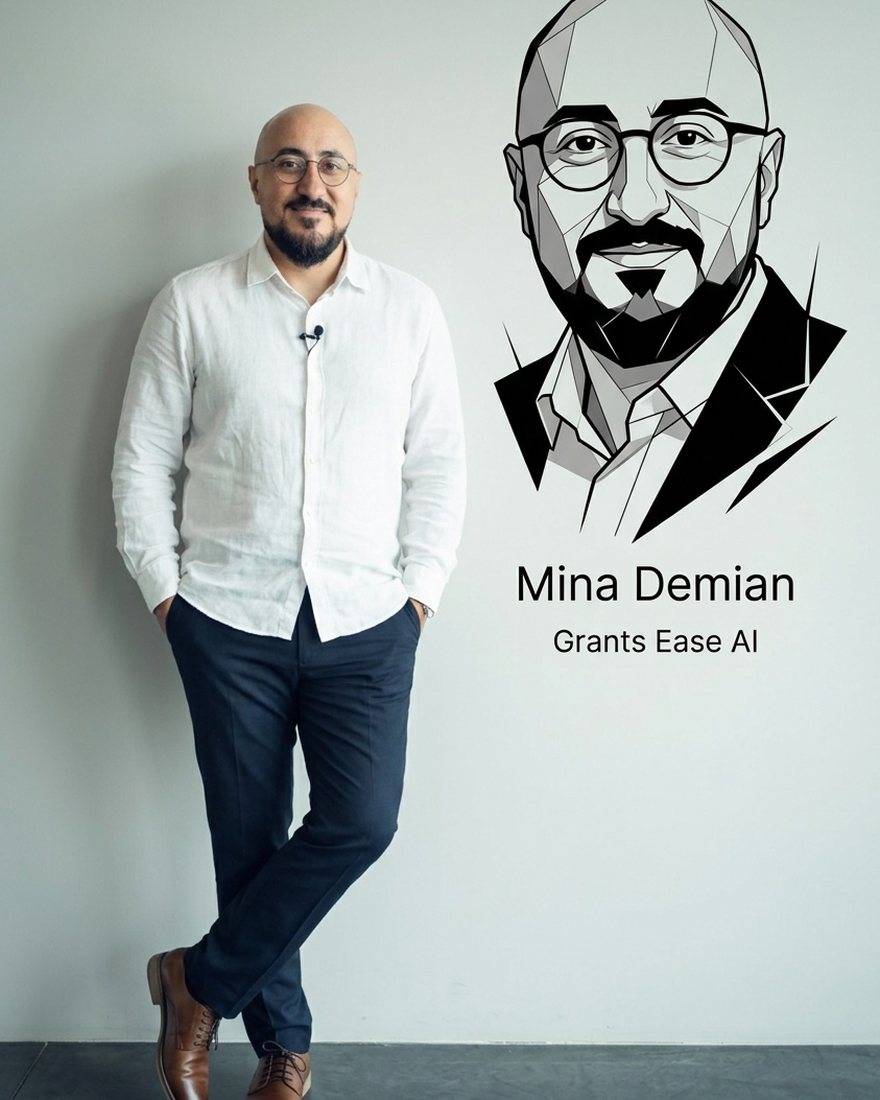
Mina
I help Canadian nonprofits and founders make funding decisions, improve workflows and turn priorities into practical next steps.
I bring more than 15 years of nonprofit funding experience and an Executive MBA in Social Enterprise Leadership. I founded Business Path and built Grants-Ease, which supports grant proposal writing using organization information, funder context and AI-assisted drafts.
Your team supplies the evidence and reviews the work. My advisory services provide the strategy, judgement and agreed delivery around that process.
- Founder, Grants-Ease
- Business Path
- 15+ years in nonprofit funding
- Calgary, Canada
Start with 15 minutes.
One call, no deck. We'll look at where your organization actually is and tell you whether this work is worth doing right now.
Prefer email? Write to mina@grants-ease.ai.
Also available: live cohort training
Grant Systems & AI Accelerator
A practical program with Mina Demian and Sara Stepa for nonprofit teams building stronger grant strategy and AI-assisted workflows. Visit the registration page for current dates, prices, payment options and included support.
The Grant Foundation
Crack the Funder Code
AI Foundations
Mission Amplification
AI-Powered Workflows
Your AI-Enhanced Grant System
Format: Live online, cohort-based, open to participants across Canada.
What's included
- Password-protected learning portal with session recordings
- Participant handbook and curated list of Alberta funders
- Certificate of completion
Led by Sara Stepa (Circles of Impact) — a former funder who teaches grant strategy from the funder's side of the table — and Mina Demian (Grants-Ease / Business Path) — 15+ years in nonprofit funding, building practical AI workflows for fundraising teams.
Not sure if you want 1:1 advisory or group training? The Advisory track above is built for organizations that want a dedicated strategist inside their systems. The Accelerator is a live, cohort-based training — same core method, taught alongside other nonprofits.